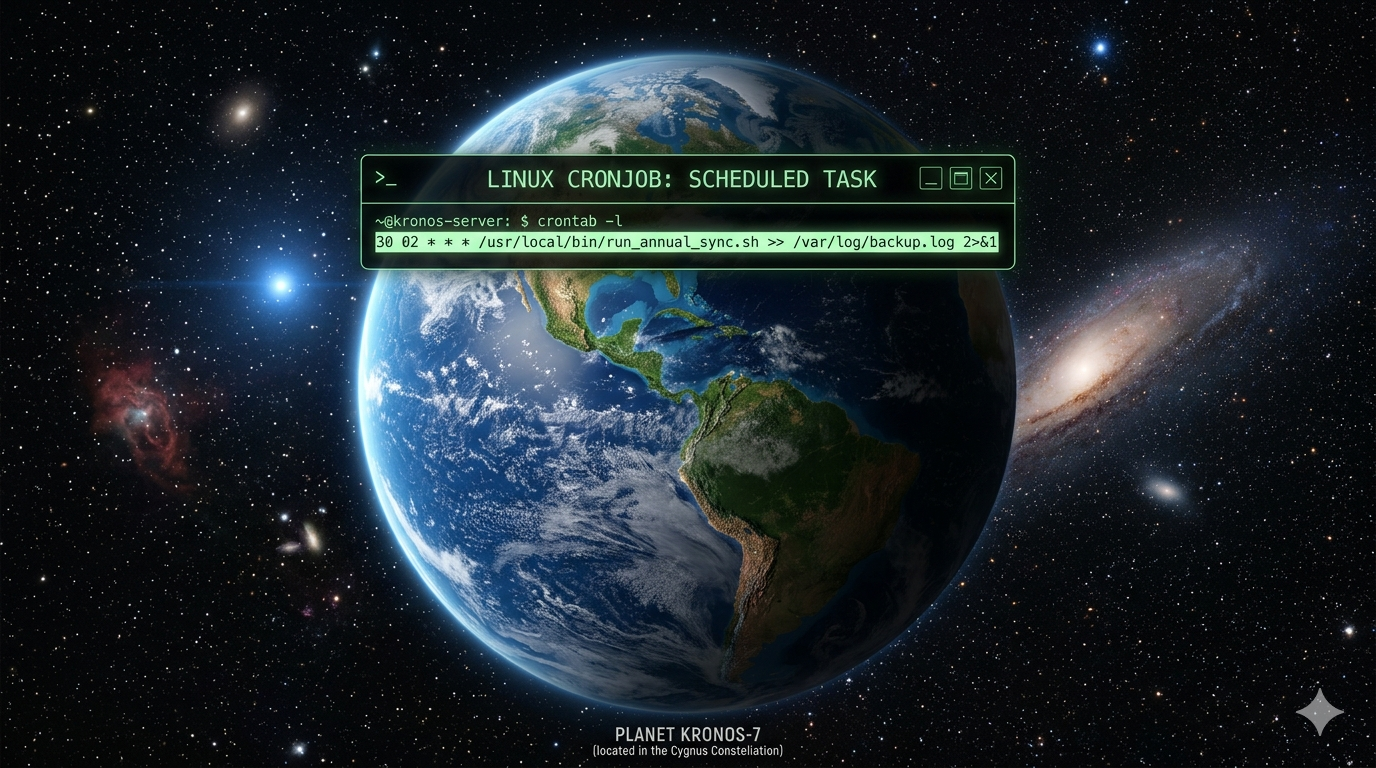
In what insiders are calling “long-term thinking taken just a bit too far”, engineers worldwide have confirmed that scheduling cron jobs on February 30th is not a bug—it’s a feature.
“It’s a clean, intentional disable,” explained one senior SRE.
“No comments, no flags, no documentation needed. You just pick a date that doesn’t exist. Future-proof.”
For years, this technique has been quietly deployed in production systems:
- Legacy cleanup scripts → February 30th
- Dangerous database migrations → February 30th
- That one job nobody understands → especially February 30th
“It’s perfect,” another engineer added.
“You don’t delete the job—you just move it… outside of reality.”
The Long Game
But here’s the twist: this isn’t just about disabling jobs.
This is about waiting.
Because deep in the back of every seasoned engineer’s mind is a quiet understanding of Earth’s rotation slowing.
The planet is, in fact, slowing down. Very slightly. Imperceptibly. But relentlessly.
Which leads to the unspoken contingency plan:
One day… we will need to add a new day to the calendar.
Not a leap second. Not a leap year.
A full. Extra. Day.
The Awakening
And when that day comes—when global authorities introduce the long-awaited:
February 30th
Everything changes.
At 00:00, dormant cron jobs—carefully entombed in impossible dates—will suddenly become valid.
Simultaneously:
- A script written in 2009 to “temporarily fix logs” executes.
- A backup job targeting a server that no longer exists begins retrying indefinitely.
- A Kubernetes cluster tries to scale a deployment that was deleted three CTOs ago.
- Someone’s
while trueloop, believed safely exiled, finally gets its moment.
One engineer described the scenario as:
“Like opening a tomb and realizing all the skeletons have shell access.”
The Final Irony
The very trick designed to disable jobs becomes the trigger that unleashes them all at once.
Not because of a bug. Not because of negligence. But because we assumed the universe would never change.
Conclusion
So yes, scheduling a cron job on February 30th is a perfectly valid way to disable it.
As long as:
The calendar remains stable
The planet keeps spinning as expected
And humanity never decides to patch time itself
Because the moment we do… every “disabled” job becomes a scheduled disaster.
[BONUS] How Long Until February 30th Becomes Real?
Earth’s rotation is gradually slowing due to tidal friction—about 1.8 milliseconds per century.
- 1 full day = 24 hours = 24 × 60 × 60 = 86,400 seconds
- Rate of change = 1.8 milliseconds per century = 0.0018 seconds per 100 years
So, at the current rate, we would need roughly 4.8 billion years before Earth slows enough to require an extra day.
That’s conveniently longer than humanity’s attention span—so your February 30th cron jobs are extremely safe… for now.
Example “Future-Proof” Crontab Comment
# WARNING: This job is intentionally disabled by setting it on Feb 30th.
# Earth is slowing at ~1.8 ms per century; full extra day arrives in ~4.8 billion years.
# If you see this run, check time sync, spacetime, and your life choices.
0 0 30 2 * /usr/local/bin/run-dangerous-job.sh